LIZA / QA ENGINEER

Case 01 · Web

Web Application Testing

Manual testing of “Our Story” — a small client-side web app. I focused on functional behaviour, negative scenarios, and Jira reports a developer can reproduce without a call.

Challenge

A small product still has state, validation, and persistence.

The application is small, but it still contains state changes, form validation, local persistence, and user interactions worth testing. I focused on functional behaviour, negative scenarios, and reproducible defect reporting.

Environment

Same setup on every ticket.

  • Project: small client-side web application — HTML / CSS / JavaScript
  • Data: browser local storage
  • macOS · Google Chrome 151.0.7922.138
  • Local run via index.html
  • Jira (SCRUM) for defect tracking

What I tested

Functional paths first. Then the cases that usually get skipped.

  • Heart counter: single click and rapid repeated interaction
  • History form: Date, Title, Subtitle, save flow
  • Required-field validation
  • Date boundary scenarios
  • Smoke testing across Reasons, Dates, and Letter screens

Issues found

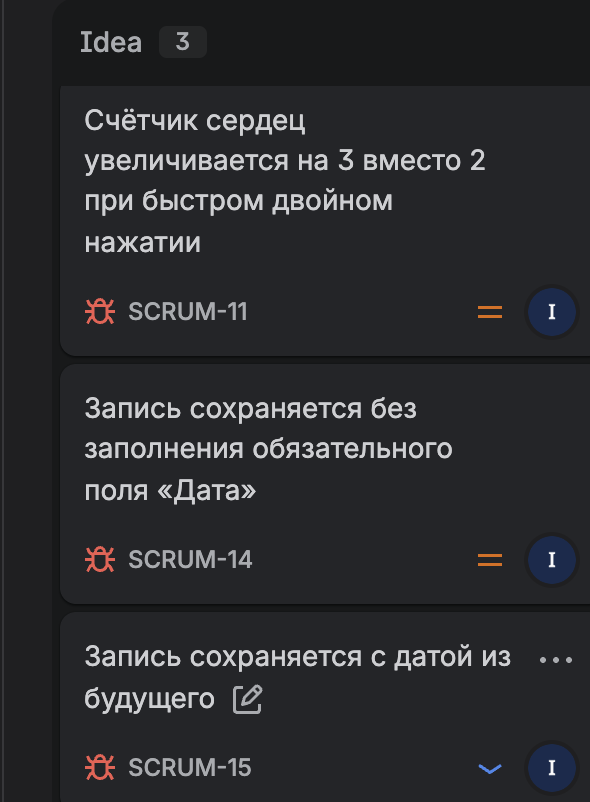
Three issues documented in Jira.

Each ticket has environment, preconditions, steps, and expected vs actual. Two are confirmed functional defects. The third is a date-boundary case that needs a product rule before it can be called a bug.

Jira board with three tickets: SCRUM-11, SCRUM-14, SCRUM-15
Jira · SCRUM-11, SCRUM-14, SCRUM-15
SCRUM-11 Bug · Medium

Heart counter increases by 3 instead of 2 on a fast double click

Счётчик сердец увеличивается на 3 вместо 2 при быстром двойном нажатии

Type
Functional · Interaction
Priority
Medium
Screen
Home
Reproducibility
5/5

Preconditions

Home page is open. Environment: macOS · Chrome 151.0.7922.138 · local index.html.

Steps to reproduce

  1. Note the current heart count
  2. Rapidly click «Добавить сердце» twice
  3. Observe the updated heart count

Expected

Each click increments the counter once. Two clicks increase the value by 2. Example: 20 → 22.

Actual

Two rapid clicks increase the counter by 3. Example: 20 → 23.

SCRUM-14 Bug · Medium

History record can be saved with an empty required Date field

Запись сохраняется без заполнения обязательного поля «Дата»

Type
Validation · Functional
Priority
Medium
Screen
History
Environment
macOS · Chrome 151

Preconditions

History page («История») is open.

Steps to reproduce

  1. Leave Date («Дата») empty
  2. Fill Title («Название») with a valid value
  3. Fill Subtitle («Подзаголовок») with a valid value
  4. Click «Добавить момент»

Expected

The record is not saved. The user is told Date is required.

Actual

The record is saved without a date.

SCRUM-15 Clarification · Low

History allows future dates with no validation or product guidance

Запись сохраняется с датой из будущего

Type
Requirement clarification
Priority
Low
Screen
History
Environment
macOS · Chrome 151

Preconditions

History page («История») is open.

Steps

  1. Set Date to a future day, e.g. 23.08.2026
  2. Fill Title and Subtitle with valid values
  3. Click «Добавить момент»

Observation

The form accepts dates later than today and stores the record.

Question

Should History contain only past events? If yes, validation should block future dates. If no, this is expected.

Finding Logged in Jira during the pass. Without an explicit rule that History is past-only, this is a product question — not a confirmed functional defect.

QA artifacts

Checklist, reports, summary.

Result

Clear reports, reproducible without extra explanation.

Testing identified two confirmed functional defects and one date-boundary scenario that needs a product rule. Each Jira ticket includes environment, preconditions, steps, and expected vs actual — or, for SCRUM-15, observation and a question for the product owner.

Confirmed

2 functional defects · SCRUM-11, SCRUM-14

Clarification

1 date-boundary ticket · SCRUM-15

Coverage

5 screens smoke-tested

Tracker

Jira defect reporting

Next case → iOS Back home